This is a Valentine from Newburgh to all those who love the place. It features the guitarist Ralph Atkins who has lived there since the 1970s. As he plays, and describes the importance of love and freedom, we catch glimpses of people who illustrate his way of life.
Friday, January 23, 2015


Monday, January 5, 2015
The Finest: Martha and The Wherehouse

Simple and perfectly cooked food at the right price, quickly made and served in soothing surroundings, Martha serves such rarities as coffee in large plain white cups and saucers, carrot butter, kimchi and curried tuna.
It is named after you know who, who's husband's headquarters stands across the street.

Almost next door is The Wherehouse, the second of the two finest of the Hudson Valley. It is scarcely soothing ― being a pub with TV and music (often live) ― but Dan Brown, the owner, can make you laugh however you are feeling. His wife Michele double checks everything—including Dan and the place runs as smoothly as silk.
Burgers etc., cooked how you expected them, are served in a room lined with vintage LP record covers. The Wherehouse also offers a selection of vegan and vegetarian fare: onion soup and vegan chili. The vinyl records from the covers are stuck to the ceiling. Lighted beer ads facing outwards are placed in the large windows and give the room a soft glow.

Monday, April 14, 2014
Kinga

The next day I took this picture. Last week I had an e-mail from a collector in Reading, Pennsylvania saying he wanted to buy a print of it. He will hang it above his desk, he told me. He had seen it several years ago on my website, always liked it and was now in a position to buy it.
Kinga is Polish. At the time I photographed her she was a housekeeper at the hotel where we were staying and was studying drama at the University of Warsaw. A few years ago her husband ask me if I would send him a print of the picture.
Sunday, April 6, 2014
Exuberant teacher, Newburgh Preparatory Charter School, Newburgh NY
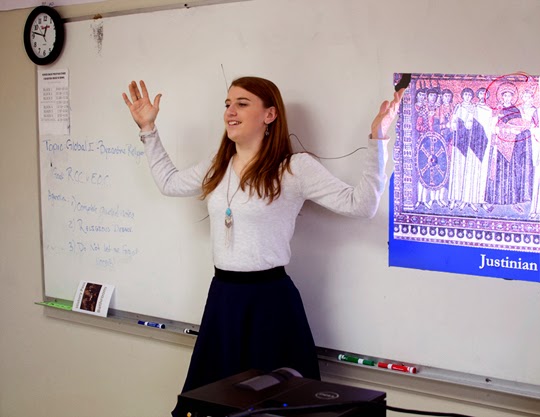
The school accepts anybody between the ages of 16 and 21 who wants to obtain a High School Diploma. The requirements are: turn up on time and regularly. You will find small classes, dedicated teachers, fair treatment, humor and worldly advice.
Monday, March 3, 2014
James Patterson, writer, film producer, philanthropist

Two weeks ago the telephone rang and Leopoldo Gout introduced himself as the executive in charge of production of a project. He told me they were making a documentary about Belle Glade in Florida, written, produced and with commentary spoken by a well known writer. The writer, he said, had seen my photographs of Newburgh and wanted to use them in his film. He was born and brought up in Newburgh and Newburgh is not unlike Belle Glade in many respects. They would also like me to photograph the writer.
"May I ask who the writer is?"
"James Patterson."
The shoot took place in Newburgh where Mr. Patterson was filming some street scenes to intercut with the main narrative in Belle Glade. The weather on the day of the shoot had began fine, but by eleven, when they wanted me to take Mr. Patterson's picture, it was raining and snowing.
I had already decided on a foul weather location. I had called Dan Brown, the proprietor of The Wherehouse, the popular pub on Liberty Street. In his back room he has a window facing north of the size that gives exactly the crisp light I like. I knew it of old, having done some pictures of Newburgh citizens there last summer.

Lunch on the river—mist and ice covered—at Cena 2000. James, his wife Susan and six film crew. Three very smartly dressed forty-year-old women were the only other guests. James asked me about my career.
"Mostly magazines doing portraits of artist and writers. Now I sell the prints to collectors." I replied.
I told him that many photographers I knew did advertising work also, and that I had tried but had not got on well. "You know what it was—you were in it once."
He said, "I've been clean for twenty years."
Friday, February 21, 2014
Stoppard and Sappho

I found myself a week later in a dimly lit waiting room in Harley Street wondering if I was really supposed to shoot Tom Stoppard together with the two or three other patients waiting for their appointments. I probably should have, but we went into Regent's Park.
Ann Margaret Daniel recently wrote an essay entitled Stoppard and Sappho in her blog for The Huffington Post using this photograph, and the Roman fresco from RegioVI (insula occidentalis) in Pompeii of Sappho.
Best Marmalade

I mostly take pictures of people, but from time to time I see an object I like or I help out with something Caroline has been asked to do in the still life realm. Recently it was a jar of marmalade.
I put the jar on our marble dining room table, clamped a spoon to a light stand and filled the spoon with marmalade. The shot was lit by four windows, two behind the jar and two in front of it. The marmalade was the best I had ever tasted, made by Jennifer Mercurio here in Garrison.
Sunday, February 16, 2014
Meursault and its woes
The wine was unrecognizable as Chassagne-Montrachet but was not poison and made good gravy for our roast chicken. It tasted, as Mr. McInerney said it might, like Sherry, due to premature oxidation as Burgundy lovers now know all too well.
I have had only excellent wine from Chambers Street Wine. Now I am going to put them to the test: Can they recommend a Meursault or Chassagne-Montrachet. If they can't, I shall probably never buy wine anywhere else—they must be honest people. If they can recommend one, and it tastes like Meursault, I shall certainly never buy wine from anyone else. At least that is what I shall feel like for a while. (But no, how could one give up Yannitelli's purring descriptions of a Bandol, or Viscount's $8 Chilean Cabernet Sauvignon, $11 anywhere else, and the always warm greeting at Artisan who recommended an $11 Soave after I asked for something to go with the last pesto of the season and it was exactly right for the dish?)
When I have found this bottle that tastes like white Burgandy I shall photograph it.
Meanwhile here are two people having a good time over a glass of something, taken in the 1970s in England at a wedding.

Saturday, February 15, 2014
Stanley Kubrick on the set of 2001: A Space Odyssey

I told him one or two stories about Stanley Kubrick. (I worked for him on three of his films as a stills photographer.) I was not able to answer his questions about Stanley's work ethic or his creative process because Stanley never talked about such things. He worked nine to five on the set, or for how ever many hours the union would allow, but come five or six o'clock, we said good night. Except for the times I went to dinner with him at his house, where we played ping pong, talked about life amongst the demi-monde in London, his children's pets, how much he loved stationary stores, and the perils of buying second hand cars, I did not see him till the next morning.
But I expect he did a lot of work on scripts. Just good old plain work. I do know, though, that if the word got out that Warner Brothers executives were planning to visit the set the following morning, Stanley would not come in. Because of the lost days, after several attempts they gave up trying to see what he was doing.
Another question was: "What was so and so like." What the question should be is: "What was so and so like in front of the camera." Because that is where your sitter is—in a very particular place, a place which elicits a different reaction from people than if you had brought them a bottle of expensive Burgundy and two glasses. Under the latter circumstances you're likely to find out more what a person, in general, is like than plonking them down in front of a camera.
My young acquaintance then e-mailed me asking for more Kubrick stories and what he called old war stories. He also asked what it is like to practice photography professionally. I was touched, but I thought, no, this is not the way to help people. I wrote back: "I am not sure that I can give you any insight into what a professional photographer needs to know or do. I have never really been one. From time to time I have earned money taking pictures but it has almost always been outside the usual places that photographers find their work. I have only had success or satisfaction when I have done what I want. This can lead to poverty by the way." I should have added that the only way was to go on taking photographs and see what happens.
He replied, but he did not take the hint. I abandoned him.
Thursday, February 6, 2014
American Cool
American Cool is the name of the current exhibition at Smithsonian's National Portrait Gallery in Washington, DC. My photograph of Jean-Michel Basquiat is included in the exhibition. The photograph was acquired by the National Portrait Gallery for their permanent collection in 2010.

I first saw Jean-Michel Basquiat one summer's day in 1986 sitting on the iron steps of Dean and DeLuca on Prince Street in Soho. He was sitting in way not unlike the pose he adopted in this photograph. He was eating Devonshire Cream with a spoon straight from the bottle.
I took this photograph some months later in his studio on Great Jones Street. When I arrived his assistant said, "He's upstairs getting ready; if you wouldn't mind waiting?” Murmuring voices and laughter, male and female, drifted down the stairs and I welcomed the time to look for a background.
It only took me five or ten minutes to decide on one. I prepared my camera and sat down. After half-an-hour I heard footsteps on the stairs and my spirits rose. It was his assistant. “Oh good, you are still here,” he said, “He won't keep you a moment.” I thanked him and he went back upstairs. I resumed listening to the chatter. Five minutes turned into ten, then twenty and then thirty. An hour past. I was getting hungry. Then I heard footsteps again, different ones this time. Jean-Michel appeared, smiled and asked, “Where would you like me?”
See CBS review
I first saw Jean-Michel Basquiat one summer's day in 1986 sitting on the iron steps of Dean and DeLuca on Prince Street in Soho. He was sitting in way not unlike the pose he adopted in this photograph. He was eating Devonshire Cream with a spoon straight from the bottle.
I took this photograph some months later in his studio on Great Jones Street. When I arrived his assistant said, "He's upstairs getting ready; if you wouldn't mind waiting?” Murmuring voices and laughter, male and female, drifted down the stairs and I welcomed the time to look for a background.
It only took me five or ten minutes to decide on one. I prepared my camera and sat down. After half-an-hour I heard footsteps on the stairs and my spirits rose. It was his assistant. “Oh good, you are still here,” he said, “He won't keep you a moment.” I thanked him and he went back upstairs. I resumed listening to the chatter. Five minutes turned into ten, then twenty and then thirty. An hour past. I was getting hungry. Then I heard footsteps again, different ones this time. Jean-Michel appeared, smiled and asked, “Where would you like me?”
See CBS review
Thursday, December 5, 2013
Anthony Powell

He seemed reasonably bright in that quick Slav manner, adapted to talk about anything. I spoke of the Fisher King novel, implications of writing about a photographer. Kasterine made an interesting and significant point that, as in other arts, a photographer will suddenly find he can take no more photographs, just like writer (sic) being written out.
This picture and others of mine are featured in The London Journal: Dmiti Kasterine's Portraits. It is written by David Secombe.
Sunday, November 24, 2013
Ballet class, Newburgh Performing Arts Academy
Many people whom I speak to in Newburgh say that there is a need for more after school programs. The only ones I know of are those run by the redoubtable couple Kim Turner and Kevin White who direct the Newburgh Performing Arts Academy and The Boys and Girls Club. One afternoon I recently attended a pre-teen ballet class. It is well known that ballet is a rigorous discipline and the class I attended bore this out. But the children plainly loved it.


Friday, November 22, 2013
Flippers
All summer we looked for the flippers whom Caroline had first seen a year ago in the park surrounding Washington's Headquarters in Newburgh. Whenever we were in Newburgh we looked out for them. Never a sign―just people saying they saw them yesterday or last week. One Saturday they actually came up to us on their bikes to say hello while we were standing talking to a friend on Liberty Street. But we were on our way to film somewhere else and there was no time to do anything.
A month later I was driving down DuBois Street and there they were. I leaped from the car and asked if I could film them there, where they stood, on that nice wide stretch of sidewalk. Thinking they might want softer ground I was prepared for them to say no. But they agreed without hesitation and giving not the slightest heed to the hard surface, and without one fall or collision with a passerby, they cartwheeled up and down. One of the group was a girl whom we had not seen before. Last semester she had won a prize for gymnastics at school .

Sunday, November 3, 2013
Waiting

Police were investigating a shooting just yards from here on South Williams Street in Newburgh, NY. People waited for something to happen. Nothing did. At last, the police, shouldering their rifles, climbed into their cars and drove away. Nobody had been hurt but somebody had been arrested. The girl above was there to see the fun with her mother, her sister and a friend, none of whom had any connection with the arrest. They talked and smoked and drank soda and asked me questions about where I came from and how long I had been working on my film.
Suddenly their friend looked at me and said, "Are you psychic?" I said no but things did pop into my head from time to time, mostly somebody's death. I discovered it to be true when I read about the death a few hours or days later.
I asked if she were psychic and she said she was.
Sunday, October 6, 2013
Eleven years later
Toni had here first child at 19. She is now 28 and has three children, the youngest of whom we see here. Toni's boyfriend is the father of all her children but he is away for a while and she misses him very much. She lives in a three room apartment with the blinds permanently down. In her neighbour's yard three dogs roam and bark; she feeds them sliced bread through a window to keep them quiet.
Toni has had to cope with a number of difficulties in her life including the murder of her niece that took place at the Newburgh Free Academy five years ago. She puts her ability to cope down to being an orphan from the age of seven. "I grew up with just me. I grew up having to survive. Maybe where I recently got my strength was from my sister, after the murder of her daughter."
 Toni, aged 17, when she replied to my request to take her picture, "Of course, the camera loves me."
Toni has had to cope with a number of difficulties in her life including the murder of her niece that took place at the Newburgh Free Academy five years ago. She puts her ability to cope down to being an orphan from the age of seven. "I grew up with just me. I grew up having to survive. Maybe where I recently got my strength was from my sister, after the murder of her daughter."

Monday, August 19, 2013
Preserving the antique...
Shelly II has lived on the farm for ten years. She has a natural gift with horses and has become highly skilled at mowing, raking and stacking hay. The video shows her working at both methods of baling, one which she likes and the other which she dislikes. Recently Shelly qualified as a nurse but she still has time to drive the tractors and bale the hay.

Friday, August 16, 2013
Mothers and children on Chambers Street in Newburgh, NY
I set up my camera amongst a gathering of 15 or so mothers and children on Chambers Street in Newburgh NY, switched it on and wandered about looking as though I did not know what to do next. This may be is why nobody really took any notice of me.

Saturday, August 10, 2013
A Calm Face in Newburgh

When I saw her in the street today I gave her a color version of this picture and she disappeared into her house for five minutes. She returned and asked when could I give her mother a copy of her picture. I thought. Who is her mother amongst the photographs I had taken of this girl's family? It could only be the one I called "Girl leaning against pillar in red and white striped shirt." I asked how old her mother was.
"She's twenty-nine ."
"How old are you," I asked.
"Thirteen."
I came home and made a print of her mother whom I had already posted, but not knowing who she was.
Sunday, July 28, 2013
Sandy's Barn Dance
For years I avoided the popular annual barn dance given by our farming neighbor, Sandy Saunders. Didn't like the music, didn't like the crowds. This year, though, as part of my venture making a film about Sandy, I went. And enjoyed every moment of it. (Well, I didn't dance because I was there to film it.) The volunteer labor force worked without a pause for ten hours preparing it and Sandy himself featured prominently in every aspect of the preparations.

Wednesday, July 3, 2013
Bare legs, undone button
 |
The girl sat down after she asked if I would photograph her. Then the legs appeared. |
Subscribe to:
Posts (Atom)